Jonathan Heights’s Last Expedition Disaster
Chasing SunlightJonathan Heights’s Last Expedition Disaster is the defining catastrophe behind Jonathan Heights’s return to Beacon and his renewed expedition aboard the Endeavor. The expedition ended with the deaths of everyone involved except Jonathan, leaving him socially isolated, financially strained, and determined to correct the failures that had made the previous journey impossible. Its legacy is not merely a lost expedition: it is the wound against which Jonathan measures honor, competence, loyalty, and the price of knowledge.
Background and Failure
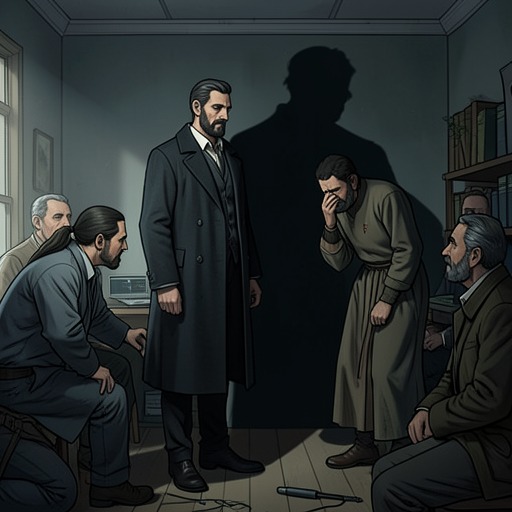
The disaster is first revealed through Eleanor McAvey’s accusation that Jonathan Heights had left her to die “like you did with old Stoneface.” Her words identify Stoneface as one of the dead associated with the earlier expedition and show that the failure has already become a moral charge against Jonathan, not simply a logistical misfortune. Jonathan rejects both parts of the accusation, insisting that he left nobody and betrayed nobody; in his account, the expedition party was simply unequal to what it discovered beyond the walls. His immediate violence toward Eleanor, gripping her throat when she questions his honor, demonstrates how closely the catastrophe is tied to his sense of personal identity.
Jonathan’s response also marks a change in the man who returned. Eleanor recognizes that he is no longer the person she knew on their previous meeting. The younger Jonathan might have tolerated mockery or accusation, but the man who has “seen the light” has little compunction about removing obstacles. The disaster has therefore produced an ambiguous transformation: it has made him more disciplined and more capable, but also more dangerous, less patient, and less willing to accept judgment from anyone who did not share the expedition’s discoveries.
The scale of the loss is reflected in Beacon’s treatment of his departure. Before the disaster, an expedition would have drawn at least a modest crowd of well-wishers. When Jonathan, Eleanor, and Inquisitor Antomine leave on the Endeavor, nobody comes to see them off. The Crown and the Reflected Council still care about the expedition, but their agents have no friends to spare. Jonathan’s last expedition has burned away his social connections along with the lives of his companions, making the new departure an institutional undertaking rather than a communal adventure.
Material and Personal Aftermath
The catastrophe damaged Jonathan’s household as surely as it damaged his reputation. Agnes tells him that the next expedition sounds dangerous, particularly after a threatening visitor appeared and Johann was attacked. Her concern recalls how strained matters became during the previous journey. Jonathan’s estate had been in good condition before he left, but he took so long to return that his finances were stretched to the breaking point. The disaster thus continued after the expedition itself, consuming time, money, and the ordinary security of the people who depended on his household.
Jonathan answers Agnes by promising more robust preparations. His assurance is practical rather than comforting: the previous failure has taught him that courage and experience alone are insufficient. The Endeavor requires extensive repair, and even with the favor of the Illuminated King, the work will take months. During that interval Jonathan opens his safe, retrieves an old leather notebook and a battered map case, and spreads his maps across his desk. Neither bears markings in any human tongue; their ciphers must be read against one another. The physical remnants of the earlier expedition therefore become working instruments for the next one, converting disaster into a program of preparation.
The maps contain more than a route east. Jonathan has charted crumbling mines, ruined cities, isolated oases, and caravan migrations from many journeys, including the ill-fated last expedition. He understands that the Endeavor cannot simply fly into the darkness and continue indefinitely. The crew will need places to rest, resupply, regain their bearings, and repair damage sustained in the black wilderness. Raw terrestrite is especially important because it can be distilled into zint fuel. The previous disaster has taught Jonathan to treat geography, fuel, maintenance, and supply as conditions of survival rather than secondary concerns.
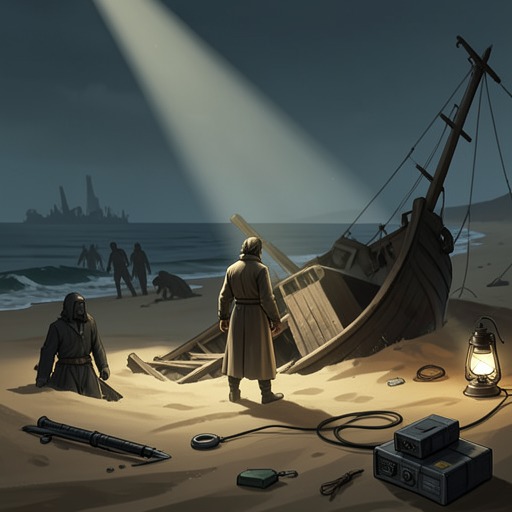
The same aftermath appears in the Endeavor itself. When Jonathan brings Eleanor to the dockyards, the ship is floating on the lowest pylon at Crowley, Stanford, and Moore. Much of it has been badly mangled, although the envelope superstructure, main beam, figurehead, and commissioning plaque survive. The plaque makes the vessel repairable rather than legally and materially equivalent to a new ship, a crucial distinction because only fools and madmen would take a brand-new airship into the dark wilds. The wreck’s partial survival allows Jonathan to continue, but it also preserves the visible evidence of how completely the previous venture failed.
Repeated Consequences on the New Expedition
The disaster remains present even when Jonathan tries to secure new allies. Eleanor asks whether he intends to leave her to die as he did Stoneface, while Captain Montgomery’s value is judged partly through the question of whether he knows how to fly beyond the walls without dying. Jonathan considers Montgomery’s experience indispensable despite the Endeavor’s ruined condition because danger remains an ordinary feature of the world outside Beacon. The new expedition is consequently built from two forms of memory: Jonathan’s knowledge of what went wrong and Montgomery’s practical knowledge of how to survive it.
The first major attack aboard the repaired Endeavor immediately confirms the wisdom of that caution. A wingsuited boarder approaches through the darkness with a small zint engine, and the glow of Jonathan’s pistol reveals several additional attackers. Zint bolts strike the hatch while other boots land on deck. Jonathan conserves his ammunition, with only nine charges left in the pistol, and draws the sword concealed in his cane because steel is faster at close range. The scene turns the previous expedition’s disaster into a tactical grammar: watch the darkness, expect betrayal, conserve scarce resources, and never assume that surviving the last failure has made the next journey safe.
The new expedition also repeats the moral burden of loss. After the destruction of Danner’s Grasp, Antomine conducts a service for three dead crew members, all recruited in Beacon. George’s casket is empty because no one attempts to recover his body from the ruined settlement. Each casket is immersed in distilled luminiferous terrestrite, rendered into dust, and dispersed in the wind. The ritual gives form to a recurring problem inherited from Jonathan’s previous expedition: bodies may be unrecoverable, the dead may be separated from their families, and survival requires the living to create ceremony amid devastation.
Jonathan’s debt to André Ludwig likewise carries the imprint of the earlier disaster. He gives André an envelope containing a forbidden fragment of knowledge, admitting that he normally does not work with such materials but had to bend his rule to secure transportation and covert assistance in returning to Beacon with his life, property, and limbs intact. Jonathan’s willingness to violate his own principles is presented as a direct consequence of needing help after the expedition went wrong. He wants an ally in the city because the opposition surrounding the Endeavor is greater than expected, and he fears what may happen while the ship remains in port.
From Disaster to Final Sacrifice
The earlier expedition’s deaths eventually become part of the moral inventory Jonathan must surrender in order to reach sunlight. At the final barrier before Bright Defile, the sacrifice of his estate burns first, followed by his connections to his chauffeur and housekeeper. Then the path is lit by the death of Tiuni, the destruction of Tor Ilek, the books thrown from the Endeavor, the laying to rest and burning of a god, the sacrifice of Angkor Leng, his lost friendship with Eleanor McAvey, and his banishment from Ukaresh. The disaster is not named as a single isolated image in this final sequence, but its logic governs the whole passage: every expedition has converted a person, place, object, or relationship into a cost that cannot be recovered.
The catastrophe’s deepest consequence is therefore not that Jonathan becomes cautious. It is that he becomes willing to treat loss as proof of commitment. He rejects the Players and their Game, sheds the cane that has accompanied him, and crosses the final gap into Bright Defile only after abandoning the remaining ties that could lead him back. The earlier expedition began this severing by leaving him the sole survivor; the later journey makes that condition deliberate and metaphysical.
Airman Stutt’s rescue provides a final contrast with Jonathan’s fate. Stutt emerges from a temporal distortion believing that only a moment has passed, while Antomine tells him that approximately five years have elapsed. Jonathan, meanwhile, looks different enough to confuse a man who knew him before. Stutt can be returned to the human world, but Jonathan has moved beyond the identity that the old expedition destroyed. His final achievement is not a conventional homecoming with a restorative gift: he reaches the sunlit country beyond Bright Defile while the shrouded lands he came from recede into insignificance.
Historical and Narrative Significance
The disaster shapes the public history of Beacon even after Jonathan’s return. The destruction of Tor Ilek produces a market for its surviving artifacts, and nearly every airman of the Endeavor becomes wealthy enough to retire or buy another ship. Some thieves target the veterans, but the men who survived the expedition are not easy victims; several would-be criminals vanish, leaving only scorched shadows. The expedition’s material aftermath is thus absorbed into commerce, private fortune, and rumor, while violence continues beneath the city’s ordinary routines.
People later call the period after the Endeavor’s return the Winter of Blood, although others mockingly propose the Winter of the Shadow. The competing names show how the disaster becomes a contested public memory: extraordinary events are recognized, but they are domesticated as gossip rather than fully understood. When Captain Montgomery outfits the Endeavor for another expedition, the planned departure attracts no more attention than a minor undertaking. The city has converted catastrophe into background noise.
For the narrative, Jonathan Heights’s Last Expedition Disaster is the absent center of the later plot. It explains Jonathan’s estrangement, his financial difficulties, the damaged Endeavor, his sensitivity to accusations of betrayal, and his insistence that the next expedition be better prepared. It also establishes the book’s recurring tension between exploration and accountability. Jonathan survives what destroys others, but survival does not absolve him; it leaves him carrying the dead, the abandoned, and the choices that made further knowledge possible. His eventual arrival in sunlight is therefore both triumph and culmination: the disaster is not overcome so much as carried forward until every remaining attachment becomes part of the price of transcendence.